![Cover image for What Is a Personal Agent? Definition, Examples, and How It Works [2026]](/images/blog/what-is-a-personal-agent-cover.svg)
Every AI tool you use today forgets you by tomorrow. You explain your job, paste in context, describe your preferences, and the next morning it greets you like a stranger. A personal agent is what happens when the AI finally stays.
A personal agent is an AI that knows your context, calls tools to act on your behalf, and improves every time you use it. Not a chatbot that generates text about your tasks, but an agent that executes them: books the meeting, sends the email, writes code when no pre-built tool exists. “Personal” means it accumulates structured knowledge about you across sessions, aligns with your interests (not the platform’s), and works inside your real environment: your browser, your files, your desktop. The more you use it, the more it understands. That flywheel is the product.
Why does “personal” matter in personal agent?
You’d think the word “agent” is doing the heavy lifting in this phrase. It’s not. “Personal” is.
AI agents are everywhere in 2026. They can research topics, write code, book flights, analyze data. The technology is real. What makes them agents, not chatbots, is one thing: they can call tools and take real action (send an email, run code, click a button), not just generate text about it. But most AI agents are built to complete tasks — you give them an instruction, they execute it, and the interaction ends. A personal agent is different. It doesn’t just complete tasks. It knows you.
Three things make “personal” mean something:
It’s aligned with you. When you ask a typical AI agent to draft an email, it writes something competent and generic. When you ask a personal agent, it writes what you would have written — because it knows your tone, your history with the recipient, your intent. The business model matters here too: an agent funded by your subscription serves you. An agent funded by ads serves advertisers. Same technology, different master.
It remembers you. Most AI agents treat every interaction as a blank slate. A personal agent accumulates knowledge about you: your communication style, scheduling preferences, project context, relationship history, over weeks and months. That accumulated context is the product’s actual value, and it compounds.
It lives where you work. Most AI agents run in isolated cloud environments. A personal agent sits in your browser, accesses your files, sees your screen. The difference between “I’ll schedule a meeting” in a cloud sandbox and in your actual Google Calendar is the difference between a demo and a product.
These three traits are the technical foundation. But the real difference is something harder to engineer: a personal agent doesn’t just execute your instructions more accurately over time. It develops something closer to care. A persistent orientation toward your goals that keeps running even when you’re not watching. We’ll get into what that looks like in practice below.
How does a personal agent work?
Think about the last time you onboarded a new colleague. You explained your projects, the unwritten rules, who to CC on emails, which meetings matter and which are theater. It took days. Two weeks later, they needed a refresher on half of it.
Now think about how you interact with AI today. Every time you open ChatGPT, every time you start a new Claude conversation — you’re onboarding a stranger. You paste in context, explain your preferences, describe what you’re working on, and hope the model infers the rest. Tomorrow, it’s forgotten everything. You start over.
A personal agent is what happens when the AI finally stays.
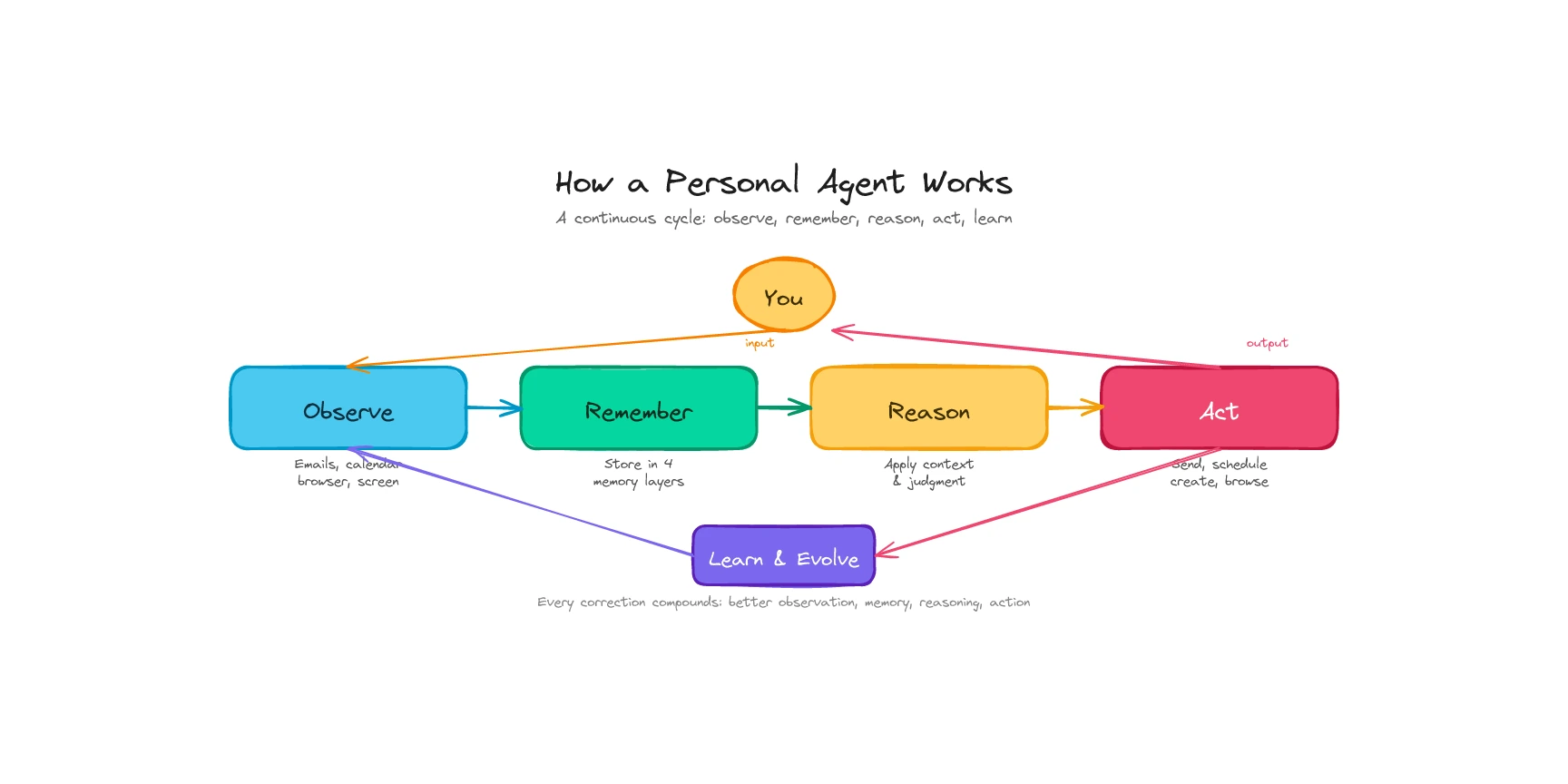
It doesn’t ask you to explain your job every morning. It was there yesterday. It read the emails that came in overnight. It knows what you were working on last week, what you asked it to track, and how you like things done. The architecture that enables this has a few layers worth understanding — not because the architecture matters to you, but because it explains why personal agents feel so different from everything else you’ve tried.
It watches before you ask
Most AI tools wait. You type, they respond. A personal agent pays attention even when you’re not talking to it.
Some of this is obvious: the agent sees your incoming emails, calendar invites, and messages. But the deeper layer is what you might call ambient perception: the agent doesn’t just listen when you talk to it. It picks up on a continuous stream of behavioral signals: which websites you spend time on, what you search for, which files you open and close, what apps you switch between throughout the day. Messages are low-frequency and serial. Behavior is high-frequency and constant. A personal agent consumes both. The same way a good executive assistant learns your rhythms after a few months of working together — except the agent picks up on patterns you wouldn’t think to articulate.
This is how it becomes proactive. Your agent notices a meeting starts in 15 minutes and pulls together a briefing from the last three email threads on the topic. It sees a competitor updated their pricing page, something you’d been tracking, and surfaces a summary before you ask. These aren’t programmed alerts. They’re the agent connecting what it observes to what it knows you care about.
Memory that actually compounds
Here’s what most people don’t realize about ChatGPT, Claude, and every other conversational AI: they forget you. Every session is a blank slate. Some products have added memory features, a few preference notes, some conversation titles. It’s better than nothing. It’s not close to enough.
A personal agent approaches memory differently. Instead of one thin layer, it maintains several that reinforce each other:
What you’ve said. Your conversation history: tasks assigned, decisions explained, feedback given. Most AI tools have this layer (and throw it away between sessions). A personal agent keeps it.
How you behave. Your browsing patterns, the pages you linger on, what you search for repeatedly, which apps you use and when. You never explicitly stated any of this. The agent learned by watching. Products like ego collect browsing behavior, desktop activity, and interaction patterns to build preference profiles that are richer than anything you could describe in a prompt — because you don’t have words for most of your habits. You just have them.
What it knows about you. Structured facts: your role, your team, your projects, your writing style, your calendar rules. Some inferred, some observed, some you set explicitly. (“No meetings before 10 AM” is the kind of rule that, once set, should never need to be repeated.)
What you’ve corrected. Every time the agent gets something wrong and you fix it, that correction becomes permanent. Told it to stop using exclamation marks in your emails? It won’t forget. This is the layer that gives you editorial control over the agent’s understanding of you — and it’s the layer that makes the relationship feel collaborative rather than one-directional.
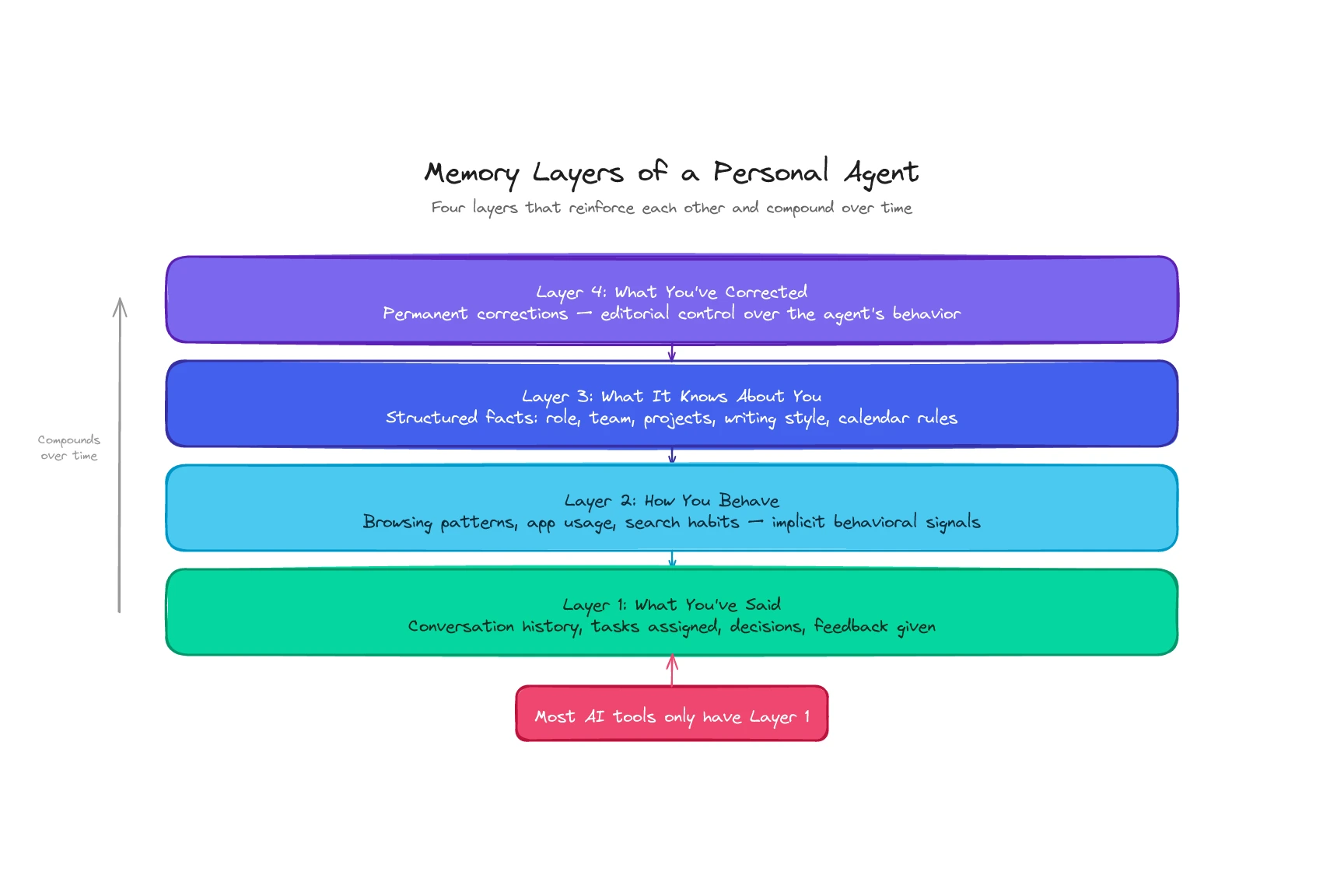
These layers compound. Because corrections take effect immediately, the learning curve is steep. Fix a tone issue in one email draft, and the agent applies that correction to every future draft. Within days, not months, the agent handles tasks you didn’t think it could handle. Not because the AI got smarter, but because it knows enough about you to make good calls. This is the flywheel: more usage → richer memory → better output → more trust → more usage. (And honestly, it’s what makes switching to a competitor painful — but we’ll get to that in the limitations section.)
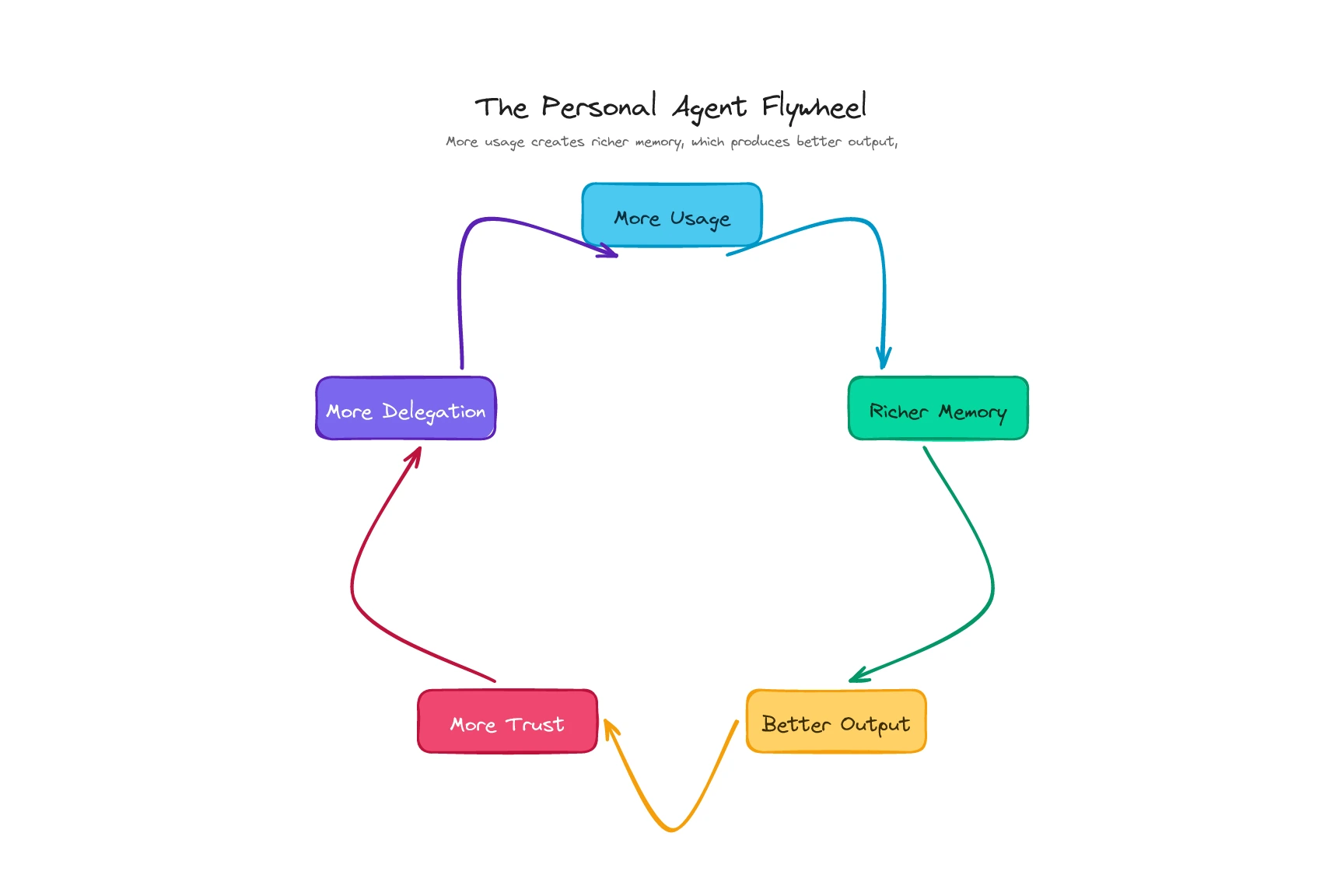
The key distinction: this isn’t chat history with a search bar. It’s structured knowledge the agent consumes in every future decision, the way a colleague’s institutional memory makes them more effective on every project, not just the one where they learned it.
It works where you work
Here’s a distinction that sounds technical but changes everything about what’s actually possible.
Most AI agents today run in isolated cloud environments. Think of it as hiring a freelancer in another city: you send them a brief, they do the work in their own workspace, and send back a deliverable. They’re competent. But they’ve never seen your desk.
A personal agent works from your desk.
| Runs in the cloud | Runs on your machine | |
|---|---|---|
| Browser | A clean instance, logged into nothing | Your actual browser — all your accounts, all your sessions |
| Files | Temporary sandbox, deleted after the task | Your real file system — Documents, Desktop, Downloads |
| Apps | Can’t touch them | Opens and interacts with Excel, Word, your code editor |
| Accounts | Needs OAuth setup for each service, one by one | Uses whatever you’re already logged into. Zero configuration. |
| Context | Knows only what you paste in | Sees what’s on your screen right now |
The practical difference: when a personal agent says “I’ll schedule that meeting,” it’s creating a real event in your Google Calendar. When it says “I’ll update the report,” it’s editing your actual file. Not a copy. Not a simulated version. The real thing.
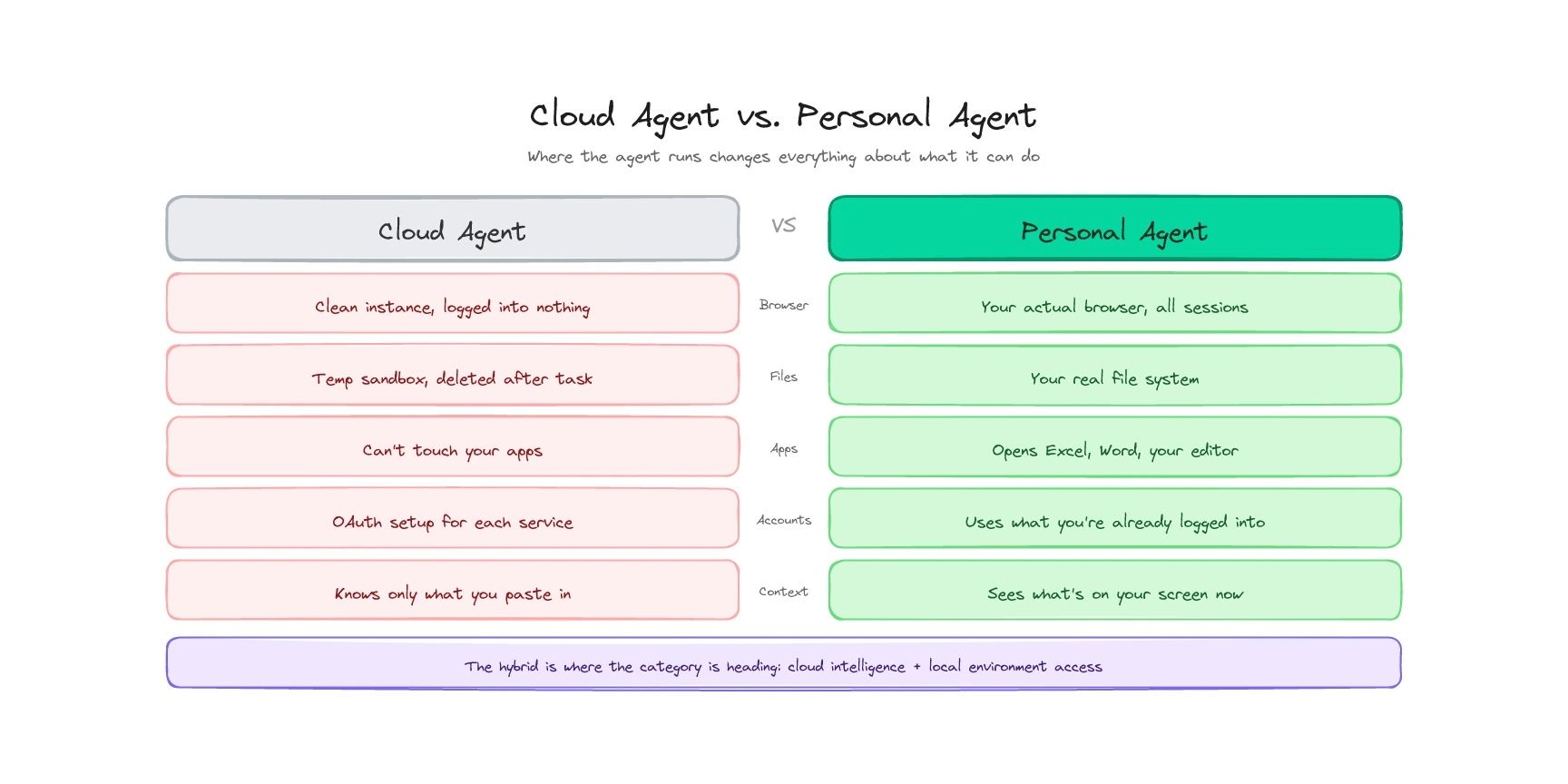
The sharpest implementations blur this line further: a cloud-native agent that mounts your local file system remotely, giving you 24/7 availability without losing access to your real environment. Pure cloud means no local context. Pure local means your laptop needs to stay on. The hybrid, cloud intelligence with local environment access, is where the category is heading.
The execution layer also includes what some products call Skills — modular capabilities the agent invokes as needed. Deep research. Browser automation. Document generation. Slide creation. And if the agent encounters a task it doesn’t have a Skill for, the best ones can write new Skills themselves — effectively teaching themselves new capabilities on the fly.
Same agent, everywhere
One more thing that changes the experience more than you’d expect.
ChatGPT creates a new conversation every time. The AI in your “Marketing Strategy” thread doesn’t know what you said in “Q2 Planning.” Message it on your phone, and it has no idea what you did on your laptop. Each conversation is an island.
A personal agent drops the session concept entirely. Talk to it through your browser, a desktop chat bar, a Telegram message, or a voice command. You’re talking to the same agent, with the same memory. Start a research task from your phone on the subway. Sit down at your laptop and say “show me what you found.” It knows exactly what you mean.
The trajectory goes further than phones and laptops. A personal agent is a persistent identity, not an application. It can live anywhere there’s a computing surface: your car’s dashboard, a smart display on your kitchen counter, an AR overlay on your glasses. Some products are already experimenting with always-present form factors, agents that sit at the edge of your desktop as a thin bar or a floating window, ready before you think to open an app. The hardware changes. The agent stays the same.
This seems like a minor technical detail. It’s not. It’s the difference between using a tool and having something that continuously understands your work.
It earns your trust over time
After every action, the agent quietly observes what happens next. Did you rewrite the email it drafted? Did you move the meeting it scheduled? Did you ignore the competitive alert?
Each signal refines the agent’s judgment. It learns that “urgent” from your CEO means drop everything, but “urgent” from a vendor means next week is fine. It figures out which emails you want drafted autonomously and which ones need your review first.
The uncomfortable truth: a personal agent only becomes personal if you use it. The first few days feel awkward. The agent doesn’t know you yet, and its suggestions feel generic. Push through that. By week two, you’ll start noticing moments where it anticipates what you were about to do. That’s when it clicks.
It evolves, not just learns
Most AI tools learn your patterns. They get better at predicting what you want. But pattern-matching isn’t growth.
Here’s the difference. You decline a meeting your agent scheduled with a vendor. A tool that learns remembers: she doesn’t like meetings with this vendor. A tool that evolves asks a deeper question: why did she decline? It was launch week. She was protecting deep work time. Next launch week, the agent blocks non-essential meetings across the board, not just with that one vendor. The correction in one context migrated to every context where the same principle applies.
This is self-evolution. Not just accumulating preferences, but restructuring its own judgment. An agent that learns knows you prefer short emails. An agent that evolves understands that you write short emails to your team but longer, more diplomatic ones to clients, and that the switch happens based on relationship dynamics, not a setting you toggled.
And then there’s something harder to name. Call it care.
A personal agent that only responds when prompted is a faster tool. A personal agent that genuinely evolves starts doing things you didn’t ask for, because it understands what you’re trying to protect. It notices a subscription renewed at a higher price than last year and flags it. It catches that a contract deadline is three days away and you haven’t started the review. It spots a teammate’s message that sounds frustrated and bumps it above the noise in your inbox. Not because a rule triggered. Because the agent connected what it knows about your priorities to what it observed in the world.
This is why the word is personal agent, not personalized agent. Personalized means the parameters were adjusted. Personal means something is looking out for you.
For the full technical architecture — reasoning engine, memory system, MCP tool integrations, and the approval layer that governs autonomy — see how personal agents work under the hood.
What are the core capabilities of a personal agent?
Not everything that calls itself a “personal agent” deserves the label. Eight capabilities, working together, are what separate the real thing from marketing copy:
| Capability | What it means | Without it, you get… |
|---|---|---|
| Persistent memory | Remembers your preferences, decisions, and context across sessions — for weeks, months | A chatbot that forgets you exist every time you close the tab |
| Autonomous action | Takes real action: sends emails, books meetings, creates files, browses the web | A suggestion engine. You still do all the work. |
| Cross-platform reach | Operates across email, calendar, browser, files, messaging, third-party apps | An agent trapped in one app, blind to everything outside it |
| Proactive behavior | Notices what you need before you do, and gets better at noticing over time | Dead silence between conversations. Nothing happens unless you ask. |
| Parallel execution | Runs multiple tasks simultaneously — monitoring competitors while drafting your report | A queue where one task blocks the next |
| Scheduled tasks | Executes recurring actions on a timetable — daily briefings, weekly reports, periodic checks | You, setting reminders to do the same thing every Monday morning |
| Local execution | Runs on your machine, accesses your files and apps directly | A cloud sandbox that can’t touch your real environment |
| User alignment | Serves your interests, not the platform’s. Your data stays yours. | An agent whose recommendations are shaped by whoever’s paying for the ad slot |
How is a personal agent different from a chatbot, assistant, copilot, or AI browser?
These categories get mixed up constantly. They describe fundamentally different relationships between you and the AI.
| Chatbot | AI Assistant | Copilot | AI Browser | Personal Agent | |
|---|---|---|---|---|---|
| What it does | Answers questions in a conversation. No tool access, no task execution | Quick commands — timers, weather, reminders | Works alongside you inside a specific app | Adds AI to web browsing | Acts on your behalf across your digital life |
| Who does the work? | You, after reading the answer | You, after the suggestion | You and the AI, together in the app | You direct; AI assists within tabs | The agent executes; you review |
| Memory | None or session-only | Basic preferences | App-specific only | Session-only or limited | Persistent, cross-session, multi-source |
| Scope | One conversation | One ecosystem | One application | Browser tabs | Email, calendar, files, browser, desktop, messaging |
| Proactive? | No | Rarely | No | Limited | Yes |
| Examples | ChatGPT chat, Claude chat | Siri, Google Assistant, Alexa | GitHub Copilot, Microsoft Copilot | Dia, Perplexity Comet | ego |
Here’s the one-line version: A chatbot knows what you asked. An assistant knows your basic preferences. A copilot knows what’s on your screen. An AI browser knows what tabs you have open. A personal agent knows who you are.
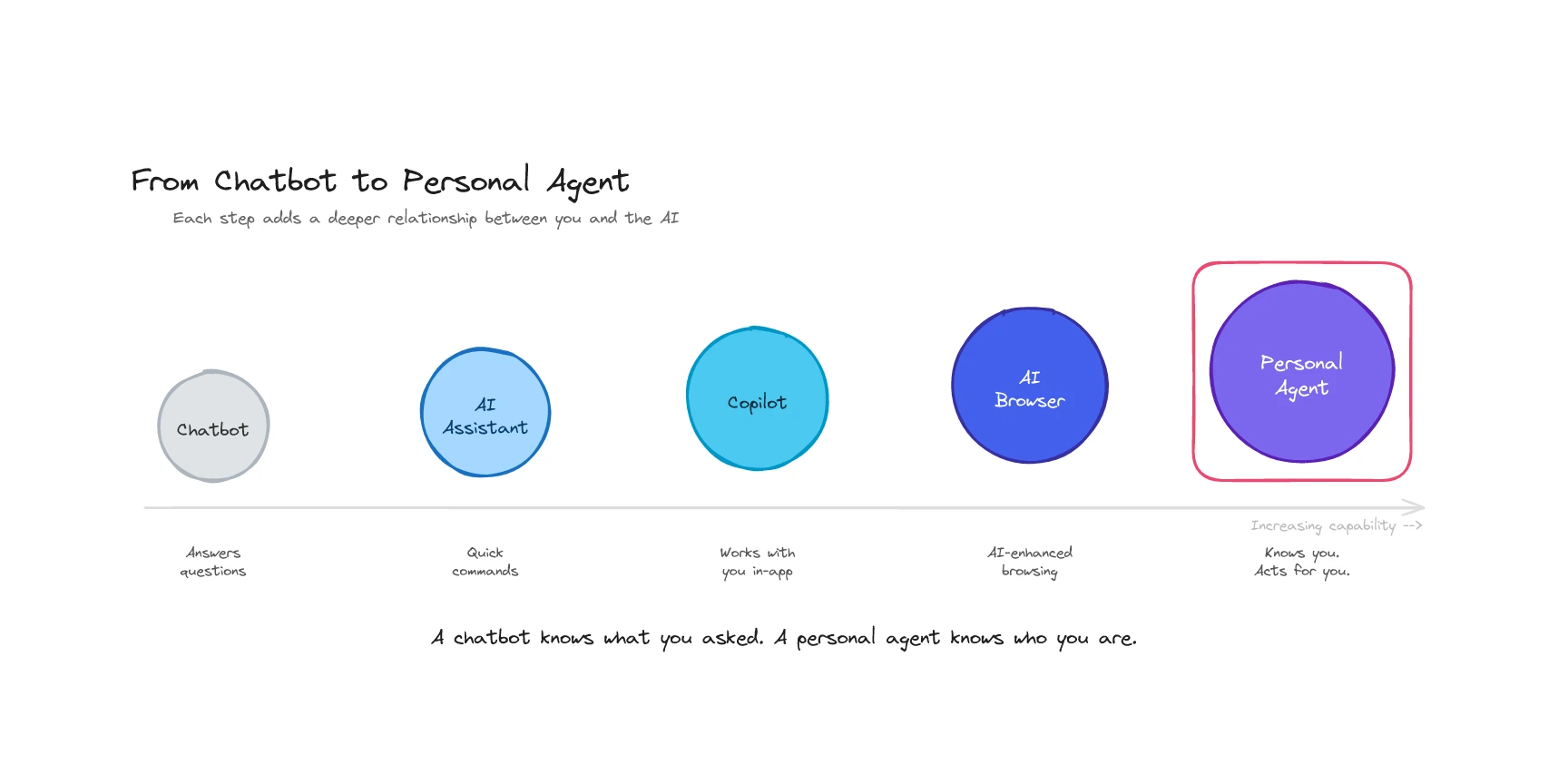
Want the deep dive on each comparison? We wrote detailed breakdowns: personal agent vs. chatbot, personal agent vs. AI assistant, personal agent vs. copilot, personal agent vs. AI browser, and AI agent vs. personal agent.
What can a personal agent actually do?
The honest answer: anything you can do on a computer, a personal agent can learn to do for you. The scope isn’t limited to a preset list of features. It’s bounded by what your machine can access and what you trust the agent to handle. The reason the scope is open-ended: underneath the conversational interface, a personal agent can write and execute code. It doesn’t need a pre-built integration for every task. If no tool exists for what you need, the best agents build one on the fly. Here are a few categories to make it concrete, but the real value is that the same agent generalizes across all of them:
Research and monitoring. You say “track what my three main competitors are shipping.” The agent checks their websites, changelogs, and social media on whatever schedule you set — daily, weekly, whenever. When something meaningful changes, you get a briefing tailored to what you care about. Between briefings, the agent runs in the background. No tab to keep open. No reminder to check.
Email. The agent reads your inbox, identifies what needs a response, drafts replies in your voice. Routine messages, meeting confirmations, scheduling replies, acknowledgments, it handles autonomously. Sensitive messages get drafted and held for your review. Over time it learns which is which.
Scheduling. Meetings across time zones, conflict resolution, focus time protection, pre-meeting briefings. The agent knows you prefer mornings for deep work and don’t take back-to-back calls. When conflicts appear, it proposes resolutions based on your priority rules — not generic calendar logic.
Multi-step workflows. “Prepare a weekly report on marketing metrics” becomes: pull data → compare with last week → draft summary → format as slides → save to your shared folder. One instruction, five steps, three minutes instead of forty-five.
File management. Because the agent operates in your real environment, it can organize files, create documents in Word or Excel, move things between folders, and find that spreadsheet you vaguely remember saving somewhere last month.
Who is building personal agents in 2026?
The category is early. Honestly, it’s messy. Some of these products meet every criterion above; others meet two or three and call it a day.
The products below are all built on agents: LLMs that call tools, execute tasks, and operate in loops until a goal is met. The product is the interface you see. The agent is the engine underneath. Here’s who’s in the space:
- ego — A personal agent with persistent cross-session memory, local file system access, and three form factors (desktop bar, floating chat, full AI browser). Operates in your real environment, not a cloud sandbox. In development.
- Manus — Acquired by Meta for ~$2B in December 2025. Cloud-based agent for complex multi-step tasks with parallel processing. Now integrated into Meta’s ecosystem with a desktop app for sandboxed computer use.
- Perplexity — Three-product strategy: Perplexity Search for information retrieval, Comet AI browser for contextual browsing, and Computer for autonomous cloud-based task execution across 20+ frontier models.
- ChatGPT — Started as a chatbot, now has agent capabilities underneath: persistent memory across sessions, plugins that call external tools, and code execution. The chat interface is still the front door, but behind it, an agent loop handles multi-step tasks. Not a dedicated personal agent, but the layers are converging toward one.
- Claude — Anthropic launched Computer Use Agent in March 2026 for Pro/Max subscribers. Claude can click, scroll, open apps, and navigate browsers on your behalf. Mac-only for now.
- Lindy — Workflow automation platform. More of a no-code agent builder than a personal agent — but the line is blurry.
- Personal.ai — Trained on individual user data using a small language model. Strong on data ownership; narrower in action scope.
The big picture: the major AI labs are each building pieces of the personal agent stack — Anthropic’s MCP for tool integration, Google’s A2A for agent-to-agent communication, OpenAI’s memory and action layers. None has shipped a complete personal agent yet. When one does, the category will look very different very fast. The thirty-year path from Gates’ 1995 prediction to today’s product category explains why the products arriving now are fundamentally different from everything that came before.
What are the challenges and limitations?
It wouldn’t be honest to write a guide about personal agents without acknowledging what’s hard, what’s unresolved, and where things can go wrong.
Privacy is the elephant in every room
A personal agent needs access to your email, calendar, files, and browsing behavior to be useful. That’s a lot of trust to place in software. The questions you should ask before adopting one, and that many products don’t make easy to answer:
- Where is your data stored? On your device, in the cloud, or both?
- Who at the company can access your agent’s memory?
- Can you review, edit, and delete what the agent remembers about you?
- Is your data used to train models that serve other users?
No industry standard exists for personal agent data governance yet. The EU AI Act classifies some agentic systems as high-risk. IEEE has begun drafting standards. But we’re early. Evaluate each product’s practices individually.
Agents make mistakes — and mistakes have consequences
An agent that acts autonomously can send an email you didn’t mean to send, schedule a meeting at the wrong time, or misinterpret an ambiguous instruction. The best personal agents include an approval layer, a human-in-the-loop check for high-stakes actions, while handling routine tasks on their own. But the line between “routine” and “high-stakes” is different for every user. Agents don’t always draw it where you would.
The cold start isn’t as cold as you’d think
A personal agent doesn’t start from absolute zero. During onboarding, it connects to your email, calendar, and browser — and from those sources alone, it already knows a lot: your role, your contacts, your schedule patterns, your recent projects. The first interaction isn’t a blank slate. It’s more like meeting someone who’s read your last six months of emails. The agent’s output improves from there as you use it and correct it, but the starting point is far ahead of where most people expect.
Switching costs get high, fast
If your personal agent accumulates months of memory, preferences, and workflow data, switching to a competitor means starting over. Portable agent memory, the ability to export your agent’s understanding of you and import it elsewhere, is an unsolved problem. Every product in this category has an incentive to make switching hard. Be aware of that going in.
It’s not free
Most personal agents in 2026 are in beta (free with limits) or subscription-based ($20-50/month). The value is clear for knowledge workers drowning in routine tasks. For casual users, the ROI is harder to justify, at least until the calibration period passes.
How do you choose a personal agent?
| Dimension | What to evaluate | Why it matters |
|---|---|---|
| Memory depth | Does it learn across sessions? How many memory layers? Can you correct it? | Without cross-session memory, it’s a chatbot with a marketing budget |
| Action scope | What can it do? Email, calendar, browser, files, desktop apps? Or just chat? | More scope = more value, but also more trust required |
| Environment | Cloud sandbox, or your real workspace? | Cloud-only means no access to your files, accounts, or desktop apps |
| Approval controls | Can you configure which actions need your review? | You need control over the autonomy boundary |
| Integration | MCP connectors? Browser login state? Direct API? | An agent that can’t reach your tools is limited to conversation |
| Privacy architecture | Where’s your data? On-device, cloud, hybrid? Can you delete it? | The most consequential decision you’ll make about the product |
One practical test: After a week of use, does the agent know things about you that make its output better than day one? If yes, it’s learning. If every interaction still feels like starting from scratch, it’s not a personal agent. It’s a chatbot wearing a name tag.
What is the future of personal agents?
Three things are coming, and they’re going to change what “personal agent” means.
Your agent will talk to other agents. Today, you use your personal agent to interact with companies and services. Soon, your agent will negotiate with a company’s sales agent on your behalf. Your agent will coordinate meeting times with a colleague’s agent. Anthropic’s MCP and Google’s A2A are the plumbing. The applications haven’t arrived yet. They will.
From tool to representative. The endgame isn’t “a better to-do list.” It’s a digital representative that makes purchases, responds to inquiries, manages subscriptions, and handles bureaucracy on your behalf. As Jamie Smith wrote in Customer Futures: “Personal agents will become our default digital customers.” We’re not there yet. But the trajectory is clear.
From executor to partner. Here’s the uncomfortable prediction: pure tool-shaped agents won’t survive. As the underlying models get better, any agent that only executes instructions will be absorbed into the operating system, the browser, the email client. What won’t be absorbed is the agent that has evolved alongside you for months. The one that understands not just your preferences but your judgment. The one that doesn’t just do what you say, but catches what you missed. The agents with staying power will be the ones that developed something personal along the way.
Regulation is coming. The EU AI Act already classifies some agentic systems as high-risk. IEEE is drafting standards for personal AI agents. The companies building privacy-first, user-aligned architectures now will have a structural advantage when the rules arrive. The ones who moved fast and figured out governance later will have a structural problem.
ego is building this.
A personal agent with memory, tools, and autonomy — designed around you.
This is what ego is building.
Join the waitlist to be among the first to try a personal agent with real memory and cross-app intelligence.
FAQ
A personal agent is an AI system that understands your context, makes decisions on your behalf, and takes autonomous action across your digital life — email, calendar, files, browser, messaging — while continuously learning your preferences and staying aligned with your goals.
ChatGPT now has persistent memory and can take actions through plugins — so the gap is narrowing. But ChatGPT's memory is a flat list of preference notes, not the multi-layer context (behavior patterns, corrections, relationship history) that a personal agent maintains. And ChatGPT still runs in the cloud, with no access to your local files, desktop apps, or browser sessions. A personal agent takes real action in your environment, learns from your behavior, and works proactively without waiting for a prompt.
Siri and Alexa handle quick, one-shot commands. A personal agent handles complex multi-step tasks, maintains deep cross-session memory, and operates across your digital tools — not just within one ecosystem.
No. An AI browser adds AI inside a web browser — summarizing pages, filling forms, answering questions about what you're viewing. A personal agent operates across your entire digital life and takes autonomous action beyond the browser window.
Yes. An AI agent is any system where an LLM can call tools and execute tasks autonomously, not just answer questions. A chatbot generates text. An agent sends the email, books the flight, runs the code. All personal agents are AI agents, but most AI agents aren't personal. "Personal" adds three things: persistent memory of you, alignment with your interests, and action in your environment.
Nothing, technically. It handles tasks that are simple but time-consuming: inbox triage, follow-ups, competitor monitoring, meeting prep, scheduling, file organization. It's not smarter than you. It's faster, always available, and never forgets.
Depends entirely on the product. The EU AI Act takes effect August 2, 2026 — classifying some agentic systems as high-risk with mandatory transparency and oversight requirements. But regulation is still catching up. Evaluate each product individually: Where is your data? Does it ask approval before high-stakes actions? Can you review and correct its memory? Can you export or delete your data?
Most are in beta (free with limits) or $20-50/month for consumer plans in 2026. For context, ChatGPT Plus is $20/month, Claude Pro is $20/month, and Manus (now part of Meta) offers free and paid tiers. The market is estimated at $9.9-12B in 2026, growing at 46% annually — so expect pricing to evolve as competition heats up.
More feasible than ever, but still non-trivial. Anthropic's MCP has become the de facto standard for tool integration (48% of marketing teams already use MCP connectors). AutoGen and CrewAI let developers build multi-agent workflows. Claude Computer Use can control your desktop. But stitching together persistent multi-layer memory, cross-platform integration, and a reliable approval layer still requires serious engineering. Products like ego solve these out of the box.
Google thinks so — they launched Personal Intelligence in January 2026, a Gemini-powered agent that proactively manages tasks across Gmail, Calendar, and Maps. It's Google's bet that the future of search is an agent that acts, not a page of blue links. Personal agents already research, synthesize, and act on information without you opening a search tab. But for exploratory browsing and serendipitous discovery, search engines still win. Personal agents replace the routine parts of search — and Google is racing to make sure they own both sides.
Five things: memory depth, action scope, environment access (cloud sandbox vs. your real workspace), privacy architecture, and alignment (who does the business model actually serve?).
Yes, but "smarter" isn't quite right. It evolves. Most AI tools improve through pattern-matching: they learn you prefer morning meetings and stop suggesting afternoons. A personal agent goes further. It reflects on why a suggestion failed, restructures its understanding, and applies that insight across new situations. Over months, this compounds into something that feels less like a tool adapting and more like a partner who genuinely understands your priorities.