Three months ago, I spent 40 minutes setting up my ChatGPT memory. Writing style. Tone preferences. Projects to track. How I like my emails to start. I closed the browser. The next morning, I opened a new chat. It greeted me like a stranger.
That’s not a bug.
A personal agent is an AI system that maintains persistent knowledge of you — built from your actual behavior, decisions, and communication patterns over weeks and months — and takes autonomous action across your real digital life on your behalf. Not inside a chat window. Across your email, calendar, files, and browser, without waiting to be asked. A chatbot answers questions. A personal agent executes goals. The gap between those two things is wider than most people realize. (“Agent” also covers software bots and autonomous programs in other fields. This article covers the AI personal-use category.)
What is a chatbot?
Think about the last time you called customer support and got routed through a menu. “Press 1 for billing. Press 2 for technical issues.” At some point, someone decided to wrap that decision tree in a text box and call it an AI. That was the first chatbot.
LLM-powered chatbots like ChatGPT, Claude, and Gemini are categorically better. They can write essays, debug code, plan a vacation, and hold conversations so fluid you briefly forget the thing on the other end doesn’t know who you are.
That’s the tell.
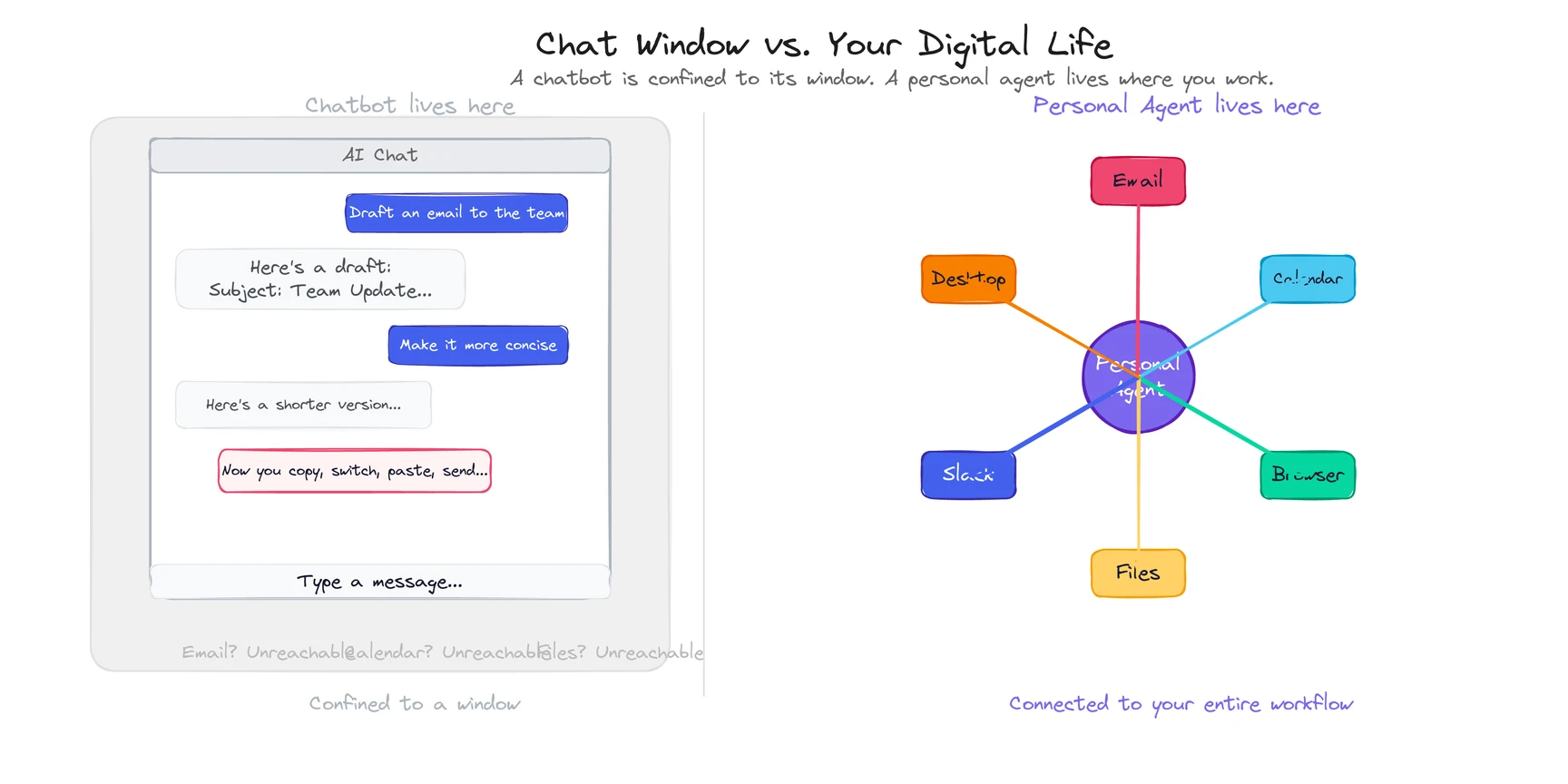
However good the conversation feels, a chatbot’s world ends at the window. You type something. It responds. You type again. It responds again. The relationship closes the moment you close the tab.
Three things define every chatbot, from the bank support bot to GPT-4o:
It responds when you ask. You drive. It follows. If you don’t type, nothing happens.
It forgets between sessions. Every conversation starts from zero. Some products have added memory features — preference notes, project names, a few sentences about who you are. It’s better than nothing. It’s not close to enough.
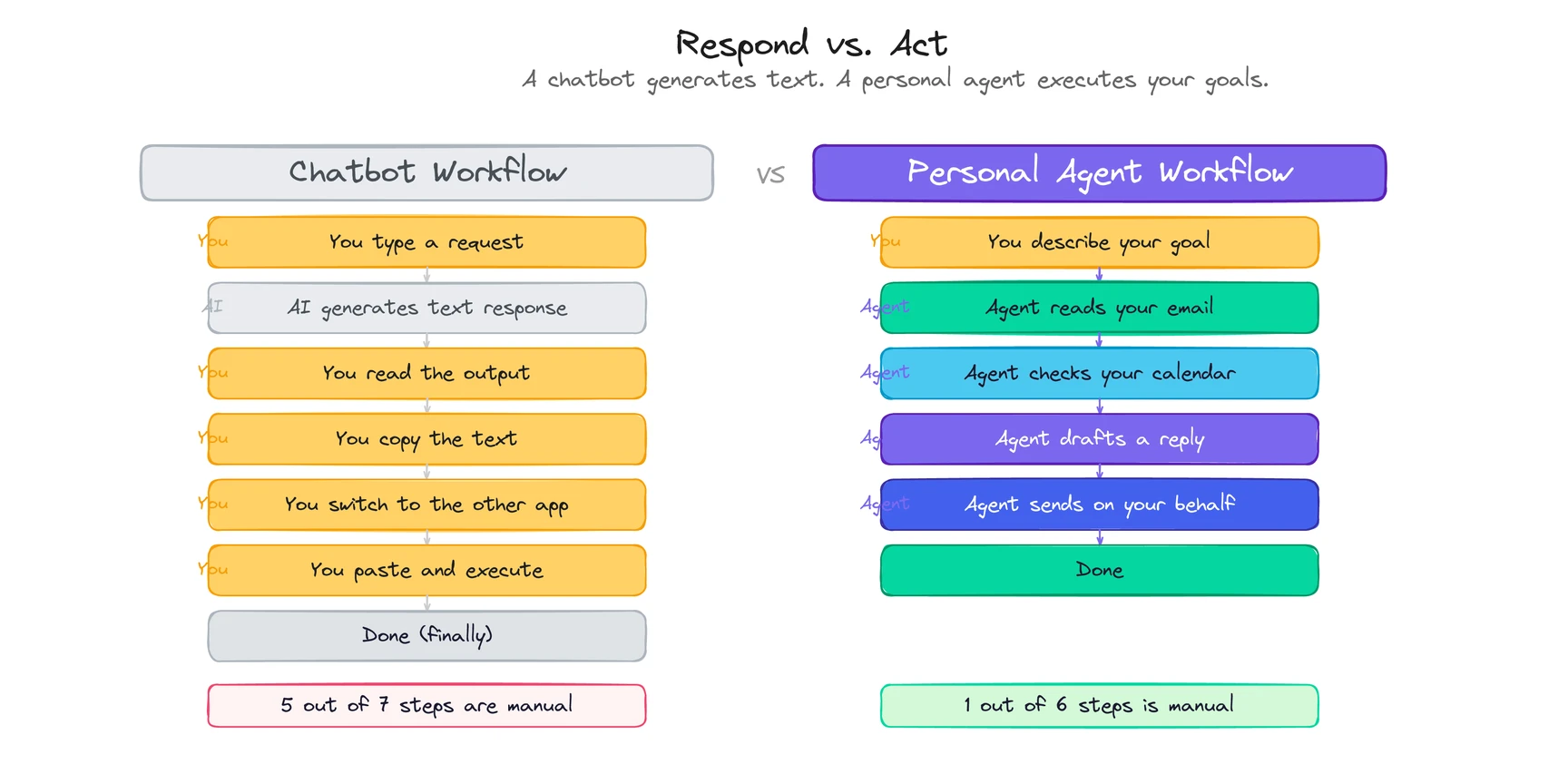
It lives in its window. No file access. No inbox. No ability to send the email you just drafted, book the meeting you just planned, or track the thing you asked it to track. It produces text. You do the rest.
These aren’t flaws. They’re design decisions. Chatbots were built to respond well, within a conversation, to whatever you give them. They’re exceptional at that job. The problem comes when you expect them to do a different job.
What is a personal agent?
Imagine you hired an executive assistant who arrived on their first day already knowing your writing style, your calendar rules, which emails you answer at midnight and which you ignore for three days, and exactly how much context you need before a meeting to not look unprepared. You didn’t tell them any of this. They learned it by watching.
That’s what a personal agent is designed to be.
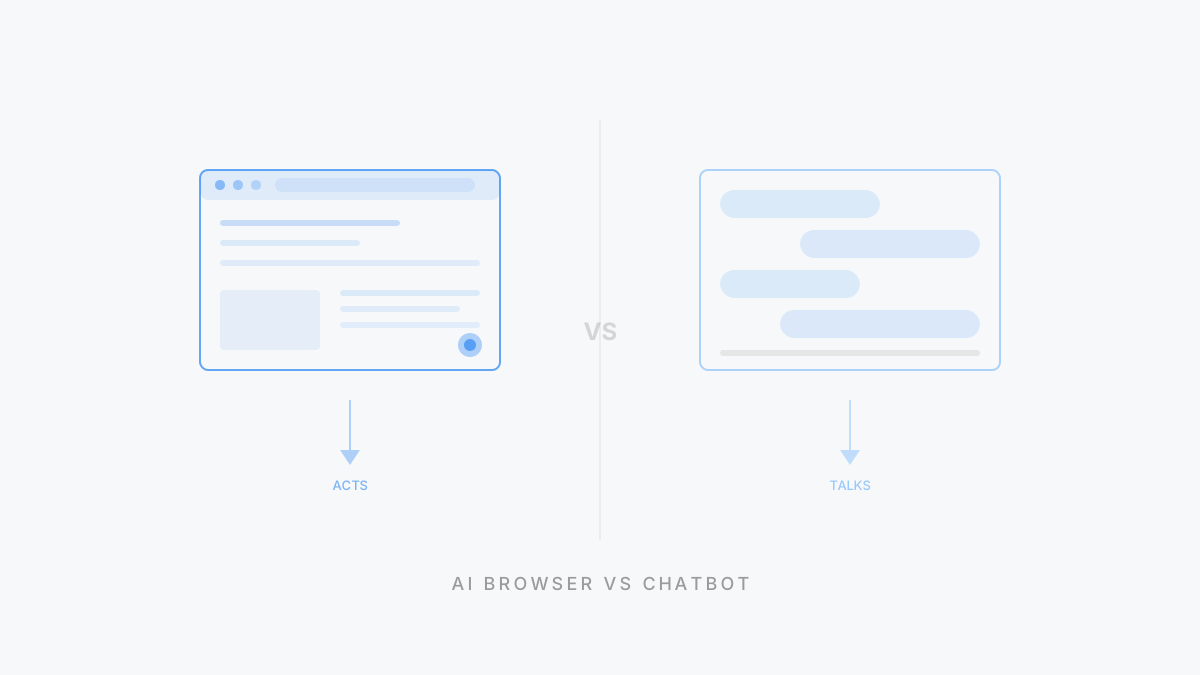
Where a chatbot resets, a personal agent accumulates. Where a chatbot responds, a personal agent acts. Where a chatbot waits for you to type, a personal agent watches — and moves before you ask.
It sees the meeting that starts in 20 minutes. Pulls the last three email threads on the topic. Sends you a briefing. You didn’t ask. It knew to do it because it knows what you care about.
This requires three things that chatbots don’t have — each fundamental to how personal agents work:
Persistent memory that compounds. Not “here’s what you mentioned once.” A behavioral profile built from how you actually work: which emails you respond to fastest, which meetings you always cancel, what you search for at 11pm, how your writing changes when you’re rushing versus when you’re careful. Products like ego build preference profiles from browsing behavior, desktop activity, and interaction patterns — richer than anything you could describe in a prompt. You don’t have words for most of your habits. You just have them.
Real-world access. The agent lives where you work — in your browser, your inbox, your files — not in a chat window you have to copy from. It can read the email, understand the context, and send the reply.
Proactive action. A chatbot waits. A personal agent watches. Sees the contract clause that doesn’t match your standard terms — and flags it before you sign.
How is a Personal Agent Different From a Chatbot?
I built this comparison after six months of watching how people actually use both. The finding that surprised me: most people don’t need a better chatbot. They need a fundamentally different category of tool.
| Dimension | Chatbot | Personal Agent |
|---|---|---|
| Memory | Resets each session (or stores thin notes) | Accumulates over weeks and months |
| Action | Produces text; you execute | Acts across real tools and systems |
| Initiative | Responds when prompted | Proactive — acts without being asked |
| Context | Knows what you type now | Knows your behavior, preferences, history |
| Personalization | You describe yourself each time | It learns who you are by watching |
| Integration | Lives in a chat window | Lives in your browser, email, files |
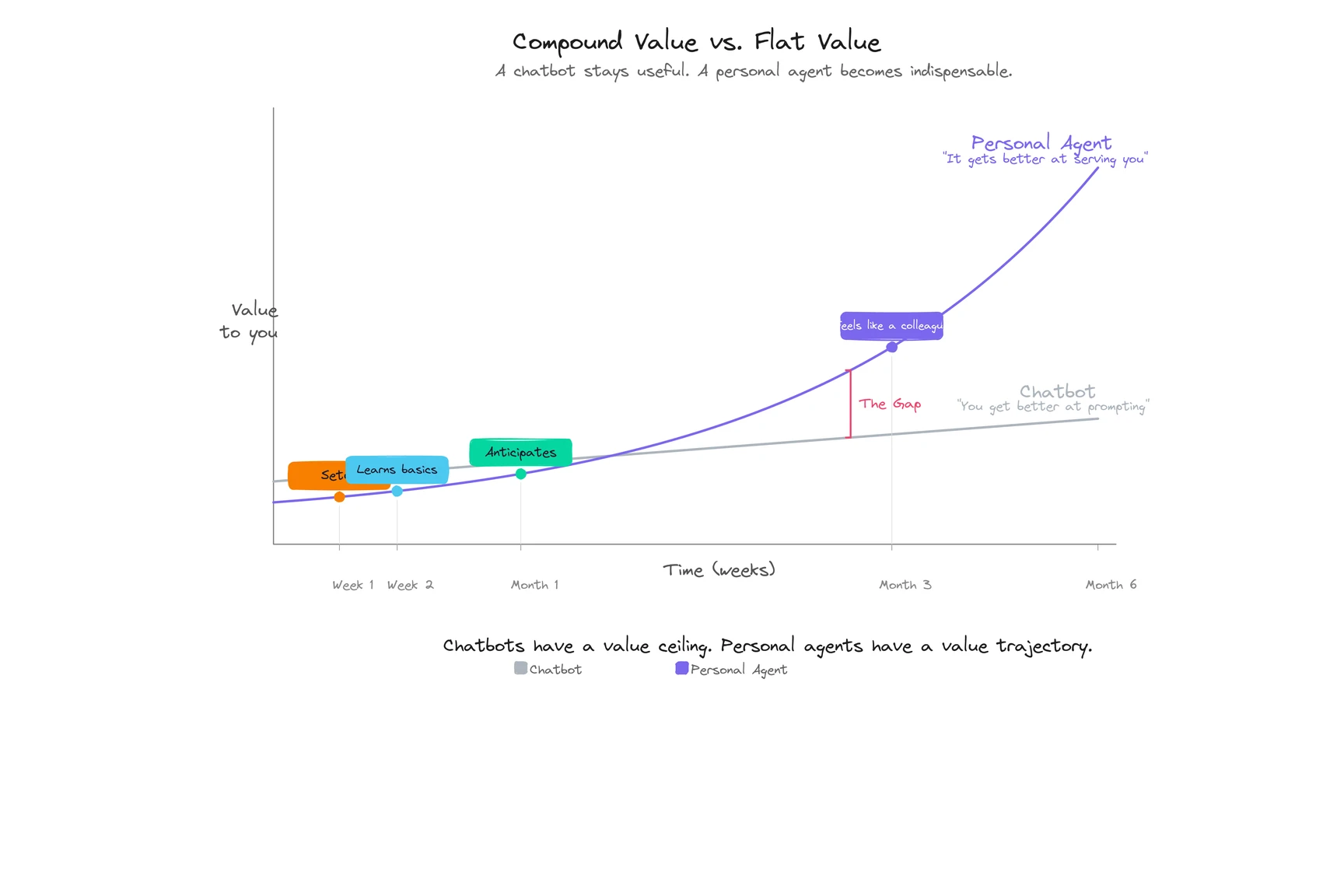
| Value over time | Flat — you get better at using it | Compounds — it gets better at serving you |
The bottom row changes everything. Compound value. The longer you use a chatbot, you get marginally better at prompting. The longer you use a personal agent, the agent gets better at understanding you. Different trajectories entirely. After a week, the difference is noticeable. After a month, it’s hard to explain to someone who hasn’t felt it.
Is ChatGPT a Personal Agent?
This is the question I get most often, and the answer is: not quite — though it’s trying.
ChatGPT has memory features. It can store preferences, use tools, browse the web, run code. OpenAI has been building toward agent capabilities for two years. If you’ve used it to search your files or execute multi-step tasks, it starts to look like something beyond a chatbot.
But look at what it still can’t do. Watch your email while you sleep. See you spend three hours on a competitor’s pricing page and connect that to the meeting you have with their customer next week. Learn that you always cancel 8am meetings. Understand that “ASAP” in your inbox from this particular person means 24 hours, not 15 minutes.
ChatGPT can do a lot. It can’t know you.
The architecture doesn’t support it. It’s a chatbot with agent features — which is meaningfully different from a system built from the ground up to serve you specifically. Knowing this distinction is what lets you use each tool correctly, instead of being frustrated when either one doesn’t perform like the other.
When Do You Need a Chatbot vs. a Personal Agent?
The right tool depends on what you’re actually trying to accomplish. I think about it this way: chatbots are for questions; personal agents are for goals.
If you need an answer, a draft, a summary, or a quick analysis — a chatbot is faster, simpler, and exactly right. It’s built for the conversation you’re having right now.
If you’re trying to actually free up time, reduce the number of things you have to track, or have something handled while you’re focused elsewhere — you need an agent. A chatbot can help you write one email. A personal agent manages your email.
Here’s how I think about which to reach for:
| Reach for a chatbot when you want to… | Reach for a personal agent when you want to… |
|---|---|
| Draft a one-off email or document | Have your inbox triaged and replied to |
| Answer a quick factual question | Track a project without checking in constantly |
| Brainstorm or explore an idea | Prepare for meetings automatically |
| Get a code snippet or formula | Monitor competitors while you sleep |
| Summarize a document you paste in | Handle recurring tasks without setting reminders |
The mistake I see most often: people try to turn a chatbot into a personal agent by giving it a long system prompt and an elaborate context document. It sort of works. You get a slightly more personalized chatbot. You don’t get a system that actually knows you, acts without being asked, or compounds value over time. That’s not what the tool was built for. You can’t get New York pizza from a Chicago-style kitchen, no matter how you adjust the recipe. (Wondering where AI assistants like Siri and Alexa fall on this spectrum? They’re a different comparison entirely — even more limited than chatbots, locked inside one ecosystem with almost no cross-session memory.)
What Are the Limitations of Personal Agents?
The enthusiast posts skip this part. They shouldn’t.
Personal agents require a kind of trust that most people aren’t ready to give. Watching your email, your browser history, your files — that’s the tradeoff. The richer the context, the better the agent. But richer context means deeper access. There’s no version where a system knows you deeply without also seeing a lot about you.
They’re also slower to set up than a chatbot, and slower to deliver value. A chatbot gives you something useful the moment you open it. A personal agent compounds over weeks. Different value proposition, and not every workflow needs it.
And their failures are harder to undo. When a chatbot misunderstands a prompt, you edit the prompt. When a personal agent acts autonomously based on a wrong inference — it scheduled the meeting you explicitly said you didn’t want, or sent the reply you hadn’t finished reviewing — the damage lands in the real world. The autonomy that makes agents powerful also makes their mistakes more consequential.
None of this makes personal agents wrong. It makes them a more serious tool that requires more intentional setup, and a harder look at what you’re actually handing over.
See the difference for yourself.
ego is a personal agent that goes beyond chatbots, copilots, and assistants.
Ready to move beyond the comparison?
ego is a personal agent built to do what chatbots, copilots, and browsers can't. Join the waitlist.
FAQ
A chatbot responds to what you type. A personal agent acts based on what it knows about you — even when you're not there.
No. A well-crafted system prompt makes a chatbot more personalized, but it can't give it real-world access, persistent behavioral memory, or proactive initiative. Those require architectural choices that happen at the product level, not the prompt level.
Not yet. The memory features improve continuity, but ChatGPT still waits for you to initiate, still lives in a chat window, and still can't take autonomous action across your real tools and systems.
No — they solve different problems. Most people will use both. Chatbots for quick, conversational tasks. Personal agents for ongoing, autonomous work.
This varies by product. The most capable agents need access to your email, calendar, browser history, and files to build genuine context. The data access is the tradeoff for the personalization.
Most products show meaningful personalization after 1-2 weeks of regular use. The compounding is real — but it starts slow. Week one is mostly setup. Week four feels different.
This depends entirely on the product's architecture and data practices. The right question isn't 'is it secure?' but 'where does my data go, who can access it, and what happens if I cancel?'