I keep a running list of AI agents I’ve tried in 2026. It’s 23 products long. Every single one can research a topic, write a draft, or automate a workflow. Not one of them remembers that I hate morning meetings.
That gap tells you everything about the difference between an AI agent and a personal agent. A personal agent is an AI that knows your context, calls tools to act on your behalf, and improves every time you use it. Every personal agent is an AI agent. Most AI agents aren’t personal agents. And “personal” isn’t a marketing adjective bolted onto the label. It’s a structural boundary that separates two different categories of product.
What is an AI agent, exactly?
Think about a freelancer you’ve never met. You send a brief. They do the work in their own workspace. They send back a deliverable. They’re competent. They’ve never seen your desk.
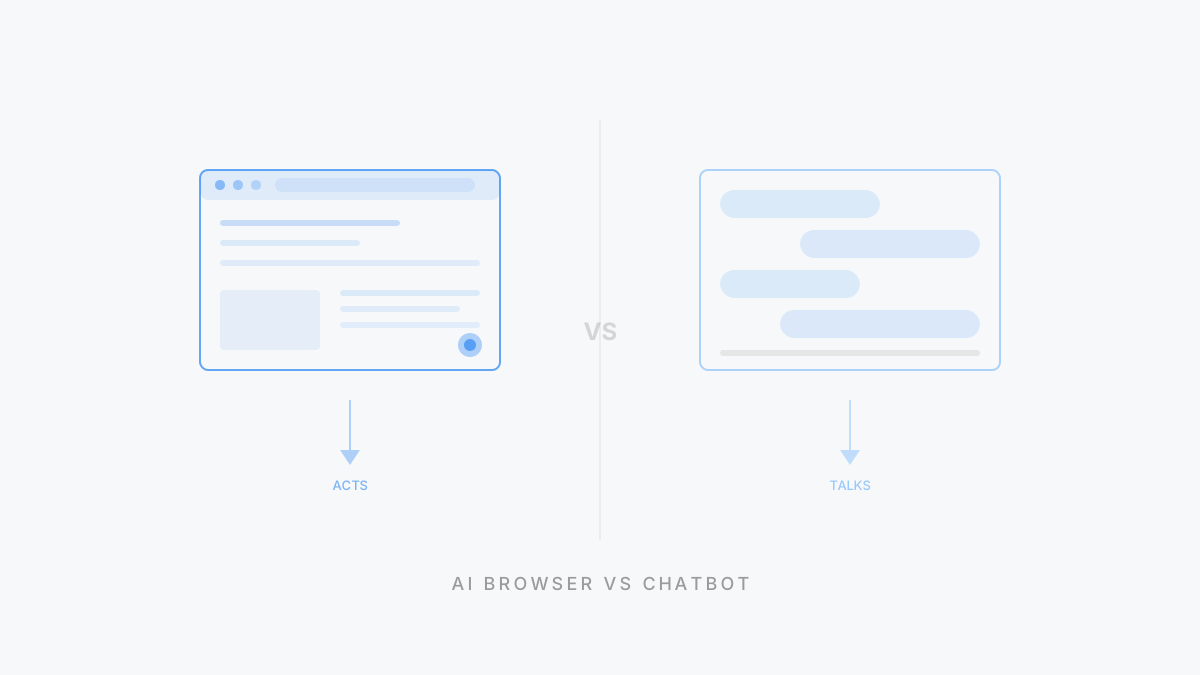
That’s how most AI agents work today. An AI agent is a software system that perceives its environment, reasons about what to do, and takes autonomous action to achieve a goal. The critical word is autonomous. A chatbot generates text about a task. An agent actually does the task: sends the email, writes the code, books the flight.
The category is huge. Salesforce Agentforce resolves support tickets. Devin writes and deploys code. Manus chains multi-step research tasks. Replit Agent scaffolds entire applications from a sentence. These are all AI agents. None of them know who you are.
That’s fine. They don’t need to. An enterprise service agent doesn’t need to learn your communication style. A coding agent doesn’t care about your calendar.
But some work is different.
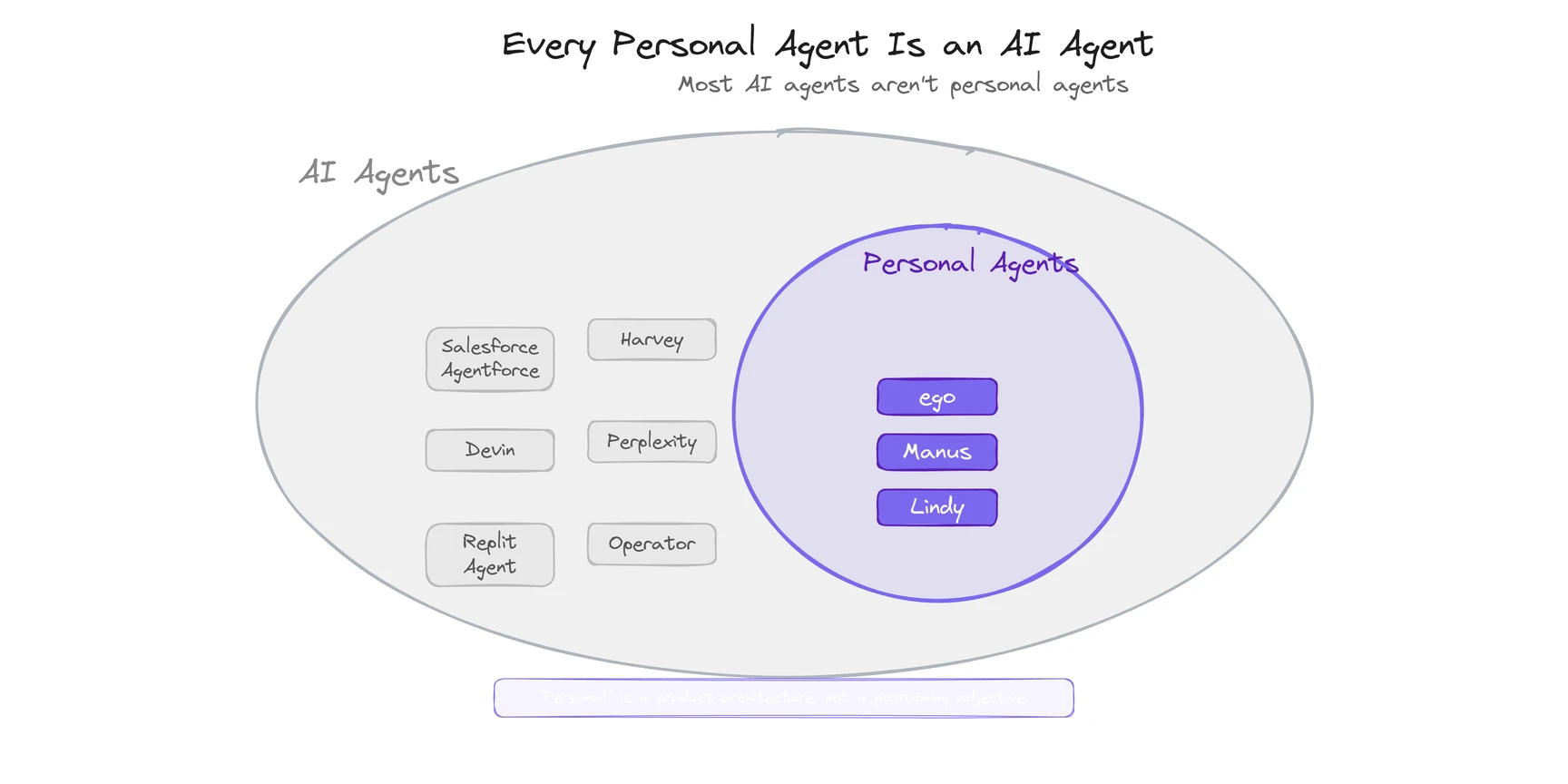
What turns an AI agent into a personal agent?
Three words draw the boundary: exclusively, learning, and across.
A personal agent is an AI agent that works exclusively for one person, learning that person’s preferences and context over time, and taking autonomous action across their entire digital life. Not one app. Not one task type. Everything.
“Exclusively” means alignment. The agent serves your interests. Not a platform’s revenue goals, not an employer’s workflow metrics, not an advertiser’s bid. When you ask it to find the cheapest flight, it finds the cheapest flight — not the one that pays the highest referral fee.
“Learning” means persistent memory that compounds. Not a preferences form you fill out once. A living model built from how you actually work: which emails you answer at midnight, which meetings you always cancel, how your writing tone shifts when you’re rushed versus careful. After a week, it drafts emails in your voice. After a month, it handles things you wouldn’t have thought to delegate. (I didn’t think I needed automated competitor briefings until one arrived at 7am and saved me 30 minutes of prep.)
“Across” means it isn’t locked inside one application. Your email, calendar, files, browser, messaging apps, third-party tools. The whole surface of your digital life.
Put those together and the result feels less like opening an app and more like working with someone who actually knows your job. That feeling is the category boundary — and one that took thirty years of failed attempts to finally arrive.
What are the structural differences between AI agents and personal agents?
The comparison isn’t one feature list against another. It’s four architectural choices that compound into a fundamentally different product.
| Dimension | General AI Agent | Personal Agent |
|---|
| Alignment | Optimized for task completion, platform goals, or employer KPIs | Optimized exclusively for one user’s interests |
| Memory | Task-scoped — remembers the current job, forgets you between jobs | Identity-scoped — remembers you across weeks and months |
| Scope | Vertical — deep in one domain (coding, support, research) | Horizontal — works across email, calendar, files, browser, desktop |
| Proactive behavior | Reactive — waits for you to assign work | Anticipatory — acts on patterns it’s learned without being asked |
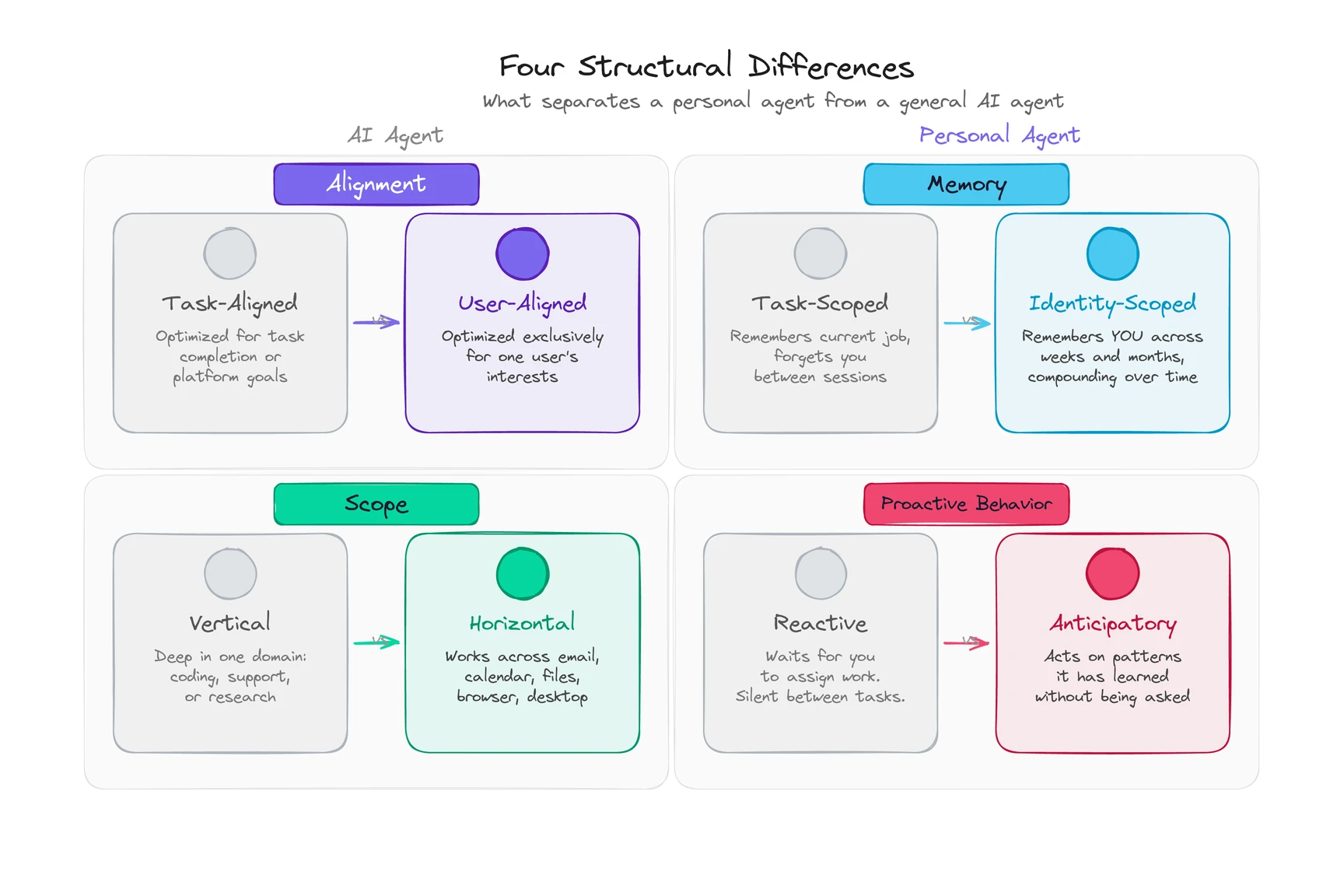
Here’s why each one matters more than it sounds.
Who does the agent actually work for?
This is the distinction most people skip.
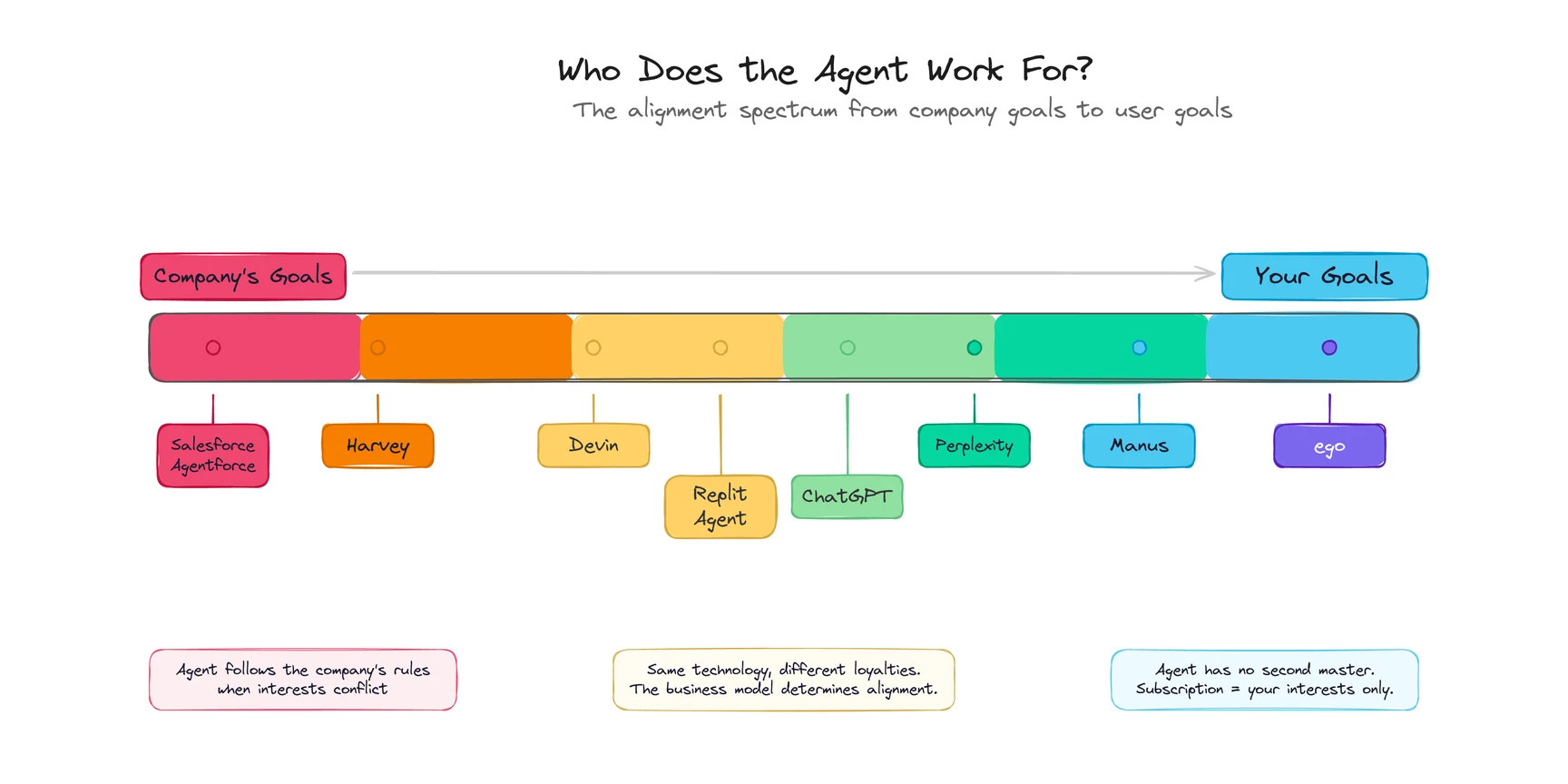
Salesforce Agentforce resolves tickets faster so the company reduces support costs. That’s the optimization target. The agent is good for the company. It might also be good for the customer. But when those interests conflict — a customer wants a refund the company prefers not to give — the agent follows the company’s rules.
A personal agent’s optimization target is you. Full stop. When Shopify’s CEO told employees in April 2025 that teams must prove a task can’t be done by AI before requesting headcount, he was describing company-aligned agents. A personal agent has no second master. The business model matters here: an agent funded by your subscription serves you. An agent funded by ad revenue serves advertisers. Same technology, different loyalties.
Does the memory survive between tasks?
Most AI agents have what I’d call “goldfish memory.” They remember everything about the current task: files read, APIs called, steps completed. The job ends, the context evaporates. Next task, blank slate.
A personal agent has identity memory. It remembers you, not just the current job. Your writing style. Your scheduling patterns. Which colleagues get immediate responses and which can wait a day. What kind of research you find useful and what annoys you. Products like ego build preference profiles from browsing behavior, desktop activity, and interaction patterns — richer than anything you could describe in a prompt, because you don’t have words for most of your habits.
The practical consequence: a general AI agent does each task equally well for any user. A personal agent does each task increasingly well for you specifically. It’s the difference between a temp worker and an assistant who’s been at your side for six months. (For the full technical architecture — the four memory layers, MCP tool integrations, and the perceive-reason-act loop — see How Do Personal Agents Work?)
See how a personal agent learns about you →
How wide can it see?
Most AI agents are vertical. Devin writes code. Harvey drafts legal documents. Agentforce handles service queues. They’re exceptional inside their lane and invisible outside it.
A personal agent is horizontal. It crosses your email, calendar, files, messaging, browser, and desktop apps. It doesn’t specialize in one kind of task. It specializes in one person and stretches general capabilities across everything that person touches.
There’s a real trade-off here. (I won’t pretend there isn’t.) Vertical agents are sharper in their domain because they’re tuned for a narrow tool set. A personal agent sacrifices that depth for breadth. The bet is that your life doesn’t happen inside one application — and the value of connecting the dots across your entire workflow outweighs being best-in-class at any single task.
Can it act before you ask?
General AI agents are reactive. You assign a task. The agent does it. Between tasks, silence.
A personal agent is proactive because it has the context to be. It knows your schedule, your priorities, your patterns. It notices you have a board meeting Thursday and haven’t opened the prep doc, so it surfaces it. It sees a reply from a client you’ve been waiting on and bumps it to the top of your attention. It runs the weekly competitor check you mentioned once, three weeks ago, because it remembers you care about it.
Proactivity requires the other three working together: alignment (it acts in your interest), memory (it knows what matters to you), and scope (it can see across your tools). Strip any one away and proactive behavior either becomes impossible or creepy. Only personal agents have all three.
That combination is the product.
Where does “personal” actually matter?
Your inbox. Your schedule. Your follow-ups. Your research. Your meeting prep. The work that falls on you as an individual, across multiple tools and contexts, day after day.
McKinsey estimated in 2023 that knowledge workers spend 60% of their time on communication, coordination, and information retrieval — not the creative or strategic work they were hired to do. A general AI agent can handle any one of those tasks if you configure it. A personal agent handles all of them because it already knows your context.
Here’s the honest version: when I first started using a personal agent for email triage, I didn’t trust it. I checked every draft it wrote. I second-guessed every scheduling suggestion. By week three, something shifted. It stopped suggesting 8am meetings (because I declined the first five). It learned which threads I respond to within an hour and which sit for two days. The output wasn’t generic anymore. It was mine.
That trust curve is the product experience. And it only happens when alignment, memory, scope, and proactivity are all present.
Explore ego — a personal agent built around you →
Where does “personal” not matter?
Not everywhere. Being honest about that is important.
If you need an AI agent to handle customer service tickets, you need an enterprise agent optimized for resolution speed and compliance. Agentforce exists for that. A personal agent doesn’t.
If you need an AI agent to write and debug code inside a specific codebase, you need a coding agent optimized for your language and deployment environment. Devin is built for that.
If you need an AI agent to generate marketing copy at scale, you need a content agent with brand guidelines and template libraries, not one that knows your personal email tone.
“Personal” in personal agent isn’t a claim of superiority over other AI agents. It’s a design constraint. The agent is built around a model of one person, optimized for one person’s interests, deployed across one person’s digital life. That’s a specific product architecture. The agents that serve companies, codebases, and workflows are different architectures solving different problems. Both matter.
The word “personal” tells you what the product is for. Not what it’s better than.